Vector RAG vs Vectorless RAG vs Graph RAG vs LLM Wiki: Which One Should You Actually Use?
After delivering 10+ RAG systems — from my own product Salesly to political campaigns and B2B enterprises — I've learned that there's no single 'best' RAG approach. Here's an honest comparison of four architectures, rooted in what actually worked (and what didn't) across real client projects.
My RAG journey started with a simple problem — and a product I was building for myself.
Salesly, my AI-powered chat assistant, needed to answer visitor questions instantly using the website owner's own data. I thought it would be straightforward: throw documents into a vector database, search by similarity, pass context to the LLM. Ship it.
It worked — until it didn't.
The moment I started onboarding real users with messy, domain-specific data, I realized that vector search alone wasn't enough. That realization set off a year-long journey through four fundamentally different RAG architectures.
Since Salesly, I've delivered more than 10 RAG systems — for political parties managing campaign knowledge bases, B2B enterprises streamlining internal documentation, German manufacturing companies needing admin dashboards over their data pipelines, and organizations that just wanted their employees to stop searching through 200-page PDFs manually.
Each project taught me something different. Each one pushed me toward a different approach.
The Four Approaches at a Glance
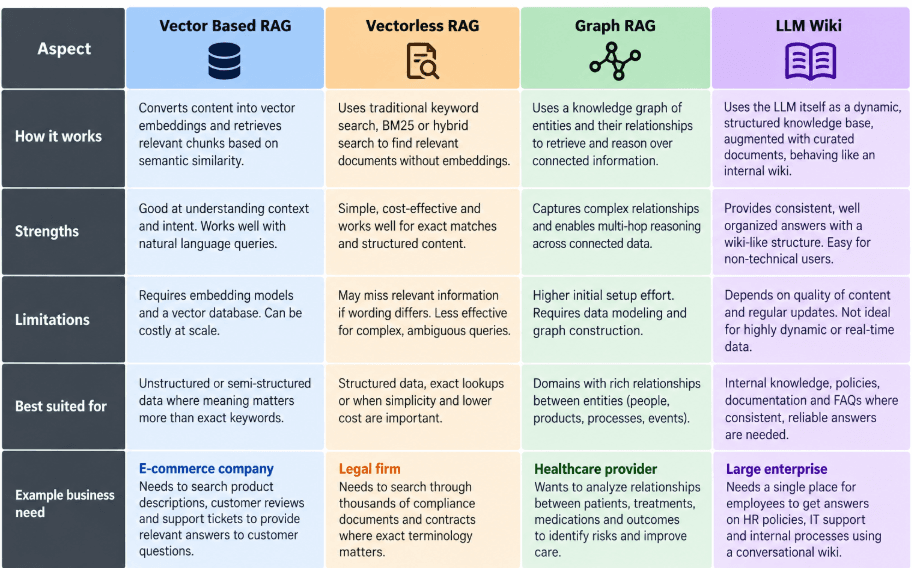
Before I walk through my experience with each, here's a visual comparison of all four side by side:
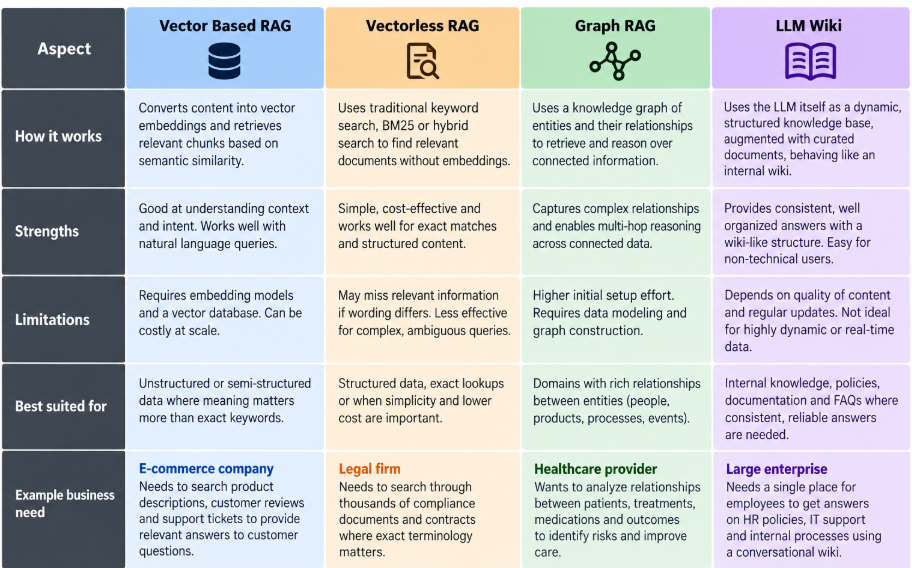
Now let me break down what I actually learned building with each one.
1. Vector Based RAG — Where Every RAG Journey Begins
This is where Salesly started, and honestly, it's where most projects should start too.
How it works:
You chunk your documents, convert each chunk into a high-dimensional vector embedding, and store them in a vector database (I've used Supabase pgvector, Pinecone, and Weaviate across different projects). When a user asks a question, you embed their query and retrieve the most semantically similar chunks. Those chunks become the LLM's context window.
Documents → Chunk → Embed → Vector DB → Semantic Search → LLM → Answer
What I liked:
- Fast to build — Salesly's first RAG prototype was working within a day
- Excellent at understanding user intent, even when the question is phrased loosely
- Works beautifully with unstructured data — product descriptions, customer reviews, support tickets
- The ecosystem is massive — tutorials, libraries, hosted solutions everywhere
Where it broke down in real projects:
With Salesly, I noticed it first. Users would ask comparison questions like "What's the difference between your Pro and Enterprise plans?" — and the system would pull chunks from both pages separately but fail to synthesize a coherent comparison. Each chunk was an island.
For a B2B client with thousands of internal documents, the cost started adding up fast. Embedding models aren't cheap when you're re-indexing weekly across millions of chunks.
Vector RAG is great when users are searching by meaning. It falls apart when they need the system to connect dots across documents.
Best suited for: E-commerce companies, support ticket search, any product where users describe what they want in natural language rather than exact keywords.
2. Vectorless RAG — The One I Underestimated
I'll be honest — when a client asked me to build a RAG system for a legal compliance use case, my first instinct was vector search. They pushed back. They wanted keyword-exact retrieval. No semantic fuzzing. No "close enough."
That's when I properly explored Vectorless RAG, and I was surprised how well it fit.
How it works:
Instead of embeddings, you use traditional keyword search — BM25, TF-IDF, or hybrid search — to find relevant documents. No embedding model, no vector database. Just precise information retrieval.
Documents → Index (BM25/Keyword) → Exact Match → LLM → Answer
What I liked:
- Zero embedding cost — for budget-conscious clients, this matters more than you think
- Blazing fast for exact terminology lookups — legal terms, policy numbers, product codes
- Dead simple infrastructure — no vector DB to manage, no embedding model to host
- Perfect when the vocabulary is consistent and domain-specific
Where it broke down:
I tried using this approach for a political party's campaign knowledge base — and it struggled badly. Campaign volunteers were asking questions in their own words, not using the exact terminology from the policy documents. "What's our stance on housing affordability?" wouldn't match a document titled "Residential Property Access Initiative."
No semantic understanding means the system is only as good as the user's vocabulary.
Vectorless RAG is the approach you reach for when your data speaks a consistent language and your users speak it too. The moment there's a vocabulary gap, it falls apart.
Best suited for: Legal firms, compliance documentation, structured technical manuals — anywhere exact terminology is a feature, not a limitation.
3. Graph RAG — When I Needed to Connect the Dots
The project that pushed me toward Graph RAG was one of the most complex I've built — a multi-domain RAG system for a political organization. They needed to analyze relationships between policies, stakeholders, regions, and campaign events. A flat vector search couldn't answer questions like "Which policy initiatives in Maharashtra are connected to the education reform our party proposed last quarter?"
That's a relationship question. You need a graph for that.
How it works:
Instead of treating documents as isolated chunks, Graph RAG builds a knowledge graph of entities (people, policies, organizations, events) and their relationships. Retrieval happens through graph traversal — following connections between entities to assemble context that spans multiple documents.
Documents → Entity Extraction → Knowledge Graph → Graph Traversal → LLM → Answer
What I liked:
- Multi-hop reasoning just works — "who worked on project X that was related to client Y?" becomes answerable
- The graph itself becomes a visual, explorable asset — clients love seeing their data as a connected map
- Perfect for domains drowning in interconnected information — healthcare, supply chains, political ecosystems
- Once built, the graph reveals patterns and connections that nobody knew existed
Where it broke down:
The setup effort is real. For the political party project, I spent significant time on entity extraction, relationship modeling, and graph construction before the system could answer a single question. For simpler use cases, this overhead isn't justified.
I also built a RAG system for a B2B manufacturing client (KLST, a German lift manufacturing company), and initially went with Graph RAG because the data had relationships — products, orders, components, customers. But the queries turned out to be mostly simple lookups: "What's the status of order #4521?" — Vector RAG would have been faster to build and just as effective.
Graph RAG earns its complexity when the questions are about relationships. If 80% of your queries are simple lookups, you're over-engineering.
Best suited for: Healthcare providers analyzing patient-treatment-outcome chains, political organizations mapping policy ecosystems, supply chain management, fraud detection — any domain where connections are the primary value.
4. LLM Wiki — The Simplest Approach That Actually Works
This is the approach I wish I'd known about earlier. For several enterprise clients, the requirement wasn't sophisticated retrieval — it was consistent, reliable answers from a curated knowledge base.
I discovered this while building internal tools for a B2B client who wanted their employees to stop pinging HR for the same 50 questions every week.
How it works:
You curate your documents into a structured, wiki-like knowledge base. The LLM uses this as its reference — think of it as giving the model its own internal Wikipedia. The structure keeps answers consistent, organized, and grounded.
Curated Documents → Wiki Structure → LLM as Knowledge Base → Consistent Answers
What I liked:
- Incredibly easy for non-technical stakeholders to maintain — it's just a wiki
- Answers are remarkably consistent — the structured format keeps the LLM grounded
- Perfect for internal knowledge management — HR policies, IT support, onboarding, SOPs
- Fastest path from "we need this" to "it's live and working"
Where it broke down:
For a client with rapidly changing product data, the wiki approach fell behind. Every update required manual curation. By the time the wiki was updated, the information was sometimes already stale.
It also doesn't scale for massive, diverse datasets. If your corpus is 100,000 documents across dozens of domains, a curated wiki structure becomes impossible to maintain.
LLM Wiki works best when you need a single source of truth that's updated periodically — not in real-time. It's knowledge management, not search.
Best suited for: Large enterprises needing a conversational interface for HR policies, IT support documentation, internal processes — anywhere consistency matters more than real-time freshness.
The Honest Comparison
Here's how all four stack up across the dimensions that actually mattered in my 10+ projects:
| Aspect | Vector RAG | Vectorless RAG | Graph RAG | LLM Wiki |
|---|---|---|---|---|
| Setup complexity | Medium | Low | High | Low |
| Semantic understanding | Excellent | Weak | Good | Moderate |
| Multi-hop reasoning | Struggles | Struggles | Excellent | Limited |
| Cost at scale | High | Low | High | Medium |
| Exact keyword lookups | Moderate | Excellent | Moderate | Good |
| Real-time data | Re-embed needed | Fast re-index | Graph rebuild | Manual update |
| Best for | E-commerce, support, unstructured search | Legal, compliance, structured docs | Healthcare, politics, supply chain | Enterprise wiki, HR, IT support |
My Decision Framework — After 10+ RAG Systems
After a year of building across all four approaches, here's the mental model I now use when a new project comes in:
Start with Vectorless RAG when:
- The data is structured and terminology is consistent (legal, compliance, technical specs)
- Users search using specific, known terms — not conversational queries
- Budget is tight and you need something live within days
- The domain vocabulary is standardized — everyone uses the same words for the same things
Go with Vector RAG when:
- Users ask questions in their own words, not domain jargon
- Your data is messy, unstructured — support tickets, reviews, internal docs
- Semantic understanding of intent matters more than exact keyword matching
- You want the largest ecosystem of tools, tutorials, and hosted solutions
Invest in Graph RAG when:
- Questions are about relationships between entities, not just finding information
- You're in a domain with rich interconnections — healthcare, politics, supply chain, fraud
- Users ask multi-hop questions: "how does X relate to Y through Z?"
- You have the engineering bandwidth for data modeling and graph construction upfront
Choose LLM Wiki when:
- You need a single source of truth for internal knowledge
- The content is curated, stable, and updated periodically (not real-time)
- Non-technical stakeholders need to maintain the knowledge base themselves
- Consistency and reliability of answers matter more than search breadth
What Production Actually Looks Like
Here's the thing nobody tells you: the best production RAG systems use more than one approach.
Across my 10+ deliveries, the most effective architectures were hybrids:
- Vector RAG + BM25 hybrid — semantic search with keyword fallback for precision (what Salesly evolved into)
- Graph RAG + Vector fallback — graph traversal for relational queries, vector search for general lookups
- LLM Wiki + Vector RAG — wiki for core knowledge, vector search for edge cases and new content
My current recommendation for most projects:
- MVP: Vectorless RAG or basic Vector RAG — get it live, learn from real user queries
- Growth: Vector RAG with hybrid search and reranking — balance precision and recall
- Enterprise: Graph RAG or LLM Wiki depending on whether your value is in relationships or consistency
What I'd Tell Myself a Year Ago
When I started building Salesly, I thought RAG was one thing — vector search plus an LLM. A year and 10+ production systems later, I know it's a spectrum of trade-offs between simplicity, cost, reasoning depth, and maintenance overhead.
The biggest mistake I made early on was picking the most sophisticated approach because it sounded impressive. The biggest lesson I learned was that the right RAG architecture is the simplest one that solves your users' actual query patterns.
Don't start with Graph RAG because it sounds cool. Don't dismiss Vectorless RAG because it sounds old. Understand what your users are actually asking, look at where your current system fails, and then add complexity only where it earns its place.
Start simple. Ship fast. Watch where it breaks. Then evolve.
That's the framework. Build accordingly.
Building a RAG system for your business? I've shipped 10+ across industries — from political campaigns to B2B enterprises. Let's talk about what fits your use case.